From Lawsonia inermis to lawsone chemistry — how a desert plant colours hair without stripping it
Henna is a natural dye made from the dried and powdered leaves of Lawsonia inermis, a flowering shrub that has been used to colour hair and skin for over 5,000 years. The reason it works so well — and so differently from chemical dyes — comes down to a single molecule called lawsone, and the way it forms a permanent bond with the protein in your hair. This guide explains the plant, the chemistry, and why that matters for anyone considering henna as a long-term hair colouring approach.
The plant: where henna comes from
Lawsonia inermis is a small, heat-adapted shrub native to North Africa, the Middle East, and South Asia. It is the only species in the Lawsonia genus — a botanical singleton — and is known by many names: mehndi in Hindi and Urdu, al-ḥinnā in Arabic, maruthani in Tamil. The English word “henna” is derived from the Arabic.
The plant thrives in semi-arid heat, producing the highest concentrations of dye when grown in temperatures between 35 and 45°C (95–113°F). The lower leaves of mature plants contain the greatest lawsone content; only these are harvested for hair and cosmetic use. After harvesting, the leaves are dried and milled into a fine green powder — the raw form most people encounter when buying henna.
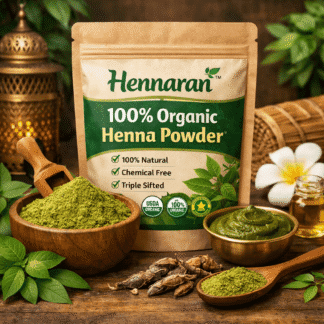
The green colour of the dry powder surprises many first-time users. It’s not a sign of anything unusual. The deep red-orange dye is locked inside the leaf matter; it’s only released when the powder is moistened and given an acidic environment to work in.
On quality
Not all henna powder is equal. Dye content, colour result, and consistency vary significantly based on plant cultivar, climate, harvest timing, milling fineness, and storage conditions. Single-origin, lab-tested powder provides greater consistency than commodity-blended product. The ingredient list for pure henna should contain exactly one item: Lawsonia inermis leaf powder.
5,000 years of use — not tradition for its own sake
Archaeological evidence places henna’s cosmetic use in ancient Egypt, where it was applied to the hair and nails of mummies — the nails of pharaohs were painted with it as part of burial rites. From there its use spread across the Middle East, North Africa, the Indian subcontinent, and parts of Europe, woven into ceremonies, rites of passage, and beauty rituals across widely different cultures.
This longevity matters for understanding henna as a hair dye. It isn’t a recent natural beauty trend. It’s a botanical tool that has been refined through continuous practical use over millennia — which is part of why its chemistry is so well understood today. The scholarly work behind modern henna science, including the research of Dr Catherine Cartwright-Jones documented at hennapage.com and mehandi.com, has given us precise molecular explanations for what traditional users had long observed empirically.
The plant was almost certainly discovered by people in hot climates who noticed its cooling and staining properties. Henna has been used as a natural coolant — applied to palms and soles of the feet in summer — in addition to its decorative and cosmetic roles. Its antifungal properties, consistent with its long use in treating dandruff and scalp conditions, are documented in pharmacological research on Lawsonia inermis extracts.
The chemistry: how lawsone colours hair
The active colouring molecule in henna is lawsone (chemical name: 2-hydroxy-1,4-naphthoquinone). This is a naturally occurring organic compound found primarily in the lower leaves of the henna plant. In dry powder form, lawsone is bound to plant matter and inactive. The process of releasing it for hair dyeing involves a precise series of steps.
Step 1: Dye release
When henna powder is mixed with a mildly acidic liquid — traditionally lemon juice, today often a fruit acid powder dissolved in distilled water — hydrolysis converts the lawsone precursors (called hennocides) into an intermediate form called the aglycone. It is this aglycone that is the active dye. In this form, lawsone becomes available to migrate out of the plant matter and into the paste, where it waits to bind to keratin.
This process takes time: at room temperature with a mildly acidic mix (target pH around 5.5), proper dye release typically takes 8–12 hours. The paste is ready when it passes a simple stain test — pressing a small amount between plastic wrap and checking that the surface shows an orange stain.
Step 2: Binding to keratin — the Michael Addition
Hair is composed primarily of keratin, a fibrous structural protein. When the dye-released henna paste is applied to hair, the lawsone aglycone molecules — being small enough to penetrate the outer layers of the hair shaft — migrate into the cuticle and upper cortex. There they undergo a reaction known as a Michael Addition, bonding permanently to the keratin protein.
This is not a surface coating that sits on top and gradually flakes away. It is a genuine molecular bond. The lawsone becomes part of the hair’s protein structure, which is why the colour is permanent and deepens over time as further oxidation occurs in the 24–48 hours after rinsing.
The chemistry in plain language
Think of the lawsone molecule as a puzzle piece with a specific shape. The keratin protein in hair has matching slots. In an acidic environment, the lawsone is converted into the right shape to fit those slots and locks in. Without the acid step, the pieces never quite fit — you get a weaker, more temporary result that gradually washes away.
Step 3: Oxidation and colour deepening
The initial colour after rinsing henna out is a bright, vivid orange-red. Over the following 24–48 hours, the bound lawsone oxidises on contact with air, shifting the colour deeper and warmer — from copper toward auburn or deeper red-brown depending on the starting hair colour and the acidity of the mix used. This oxidation window is why experienced henna users judge colour results at 48 hours, not immediately after rinsing.
How henna differs from chemical hair dye
Understanding henna’s mechanism makes the contrast with conventional oxidative dyes very clear. The two approaches work in fundamentally opposite ways.
| Aspect | Henna (pure) | Chemical oxidative dye |
|---|---|---|
| How it enters the hair | Lawsone molecules are small enough to penetrate the cuticle without forcing it open | Ammonia lifts and opens the cuticle scales to allow dye molecules to enter the cortex |
| What it does to natural pigment | Does not affect melanin — colour is layered over the top as a translucent stain | Hydrogen peroxide bleaches existing melanin, then deposits synthetic colour |
| Effect on hair structure | Reinforces the keratin cuticle; hair typically feels stronger and smoother | Cuticle is lifted and often left partially raised; repeated use leads to dryness and breakage |
| Colour permanence | Permanent via molecular bond; colour deepens over time, never fades out completely | Permanent until new growth; colour molecules can migrate out over time, causing fading and brassiness |
| Lightening ability | None — cannot lighten hair | Can lighten to any shade with sufficient peroxide |
| Colour range | Reds, auburns, coppers, and — with indigo and cassia — browns and near-black | Full spectrum including blondes, pastels, and fashion colours |
| Key ingredients | Lawsonia inermis leaf powder | Ammonia, hydrogen peroxide, p-phenylenediamine (PPD), synthetic colorants |
| Scalp chemistry | Mildly acidic; soothing; antifungal | Strongly alkaline; can cause irritation, sensitisation, and scalp burns |
The key structural difference is this: chemical dyes produce colour by destructive substitution — they remove what’s there and replace it. Henna produces colour by addition — it layers a translucent stain over the existing hair structure without disturbing it. This is why henna-treated hair tends to look and feel healthier than chemically dyed hair even at equivalent colour intensity.
The translucence advantage
This point deserves its own explanation because it accounts for one of the most distinctive visual qualities of henna colour. Natural hair is not uniformly pigmented. Melanin is distributed unevenly within the cortex, which means natural hair both reflects light from its surface and allows light to pass through it — creating depth, dimension, and the characteristic way natural hair catches sunlight differently depending on the angle.
Synthetic dyes tend to over-saturate the hair with pigment, filling in all that dimensional variation with a flat, uniform colour. This is why heavily chemically dyed hair can look noticeably artificial — the monochromatic flatness is a giveaway even when the shade itself is convincing. Henna’s lawsone stain is translucent: it adds a tint without masking the underlying structure, so the hair retains its dimensional character. The result is colour that looks like it belongs there.
What colour will henna give on my hair?
Because henna is a translucent stain layered over existing hair colour, the result is not fixed — it’s a product of starting colour and dye intensity combined. Henna cannot lighten hair. It can only add warm orange-red tones on top of whatever natural (or previously coloured) base is present.
White or grey hair
Vivid copper to bright auburn
Grey and white hair takes henna exceptionally well — no melanin to compete with, so the full lawsone colour shows clearly. Results are often the brightest and most saturated of any starting shade.
Blonde or light hair
Golden copper to strawberry red
Light hair picks up strong warmth. The result depends on natural undertones — ash blondes will read more copper; golden blondes more strawberry-red.
Medium brown hair
Rich auburn to warm chestnut
The most classic henna result on brown hair. Depth and warmth increase with each application as lawsone builds in the hair shaft over time.
Dark brown or black hair
Subtle warm gloss; copper in direct sunlight
Henna is still visible on dark hair — as a warm luminosity rather than an obvious colour shift. Most noticeable in bright light or direct sun. Repeated applications intensify the effect.
To achieve colours beyond reds and coppers — browns, deep burgundies, near-black — henna is combined with other plant dyes. Indigo (Indigofera tinctoria) contributes blue tones that combine with henna’s red-orange to produce a full range of natural-looking brunette and black shades. Cassia (Cassia obovata) can be used to dilute henna’s red intensity or, on light or grey hair, to produce golden tones on its own. Amla (Indian gooseberry) shifts henna colour cooler and deeper. These combinations are detailed in our companion mixology articles.
Why people choose henna: the honest case for it
Ingredient simplicity
Pure henna has one ingredient. For anyone who has studied a chemical hair dye label — ammonia, hydrogen peroxide, resorcinol, PPD, and a long tail of stabilisers and developers — that simplicity is significant. People transitioning away from oxidative dyes for reasons of scalp sensitivity, chemical exposure, or personal preference find henna’s ingredient profile genuinely different in kind, not just in degree.
It is important to be precise here: pure Lawsonia inermis powder is the product with this profile. Products labelled “black henna” or pre-mixed “henna” blends may contain PPD, metallic salts, or other additives that carry real risks. Checking the full ingredient list is not optional — it’s the first step.
Important distinction
Pure henna is recognised as safe for cosmetic hair use (listed at 21 CFR §73.2190 in the US). “Black henna” products — which often contain para-phenylenediamine (PPD) and are associated with serious allergic reactions — are a completely different category. Always check that the only botanical ingredient is Lawsonia inermis leaf powder.
Structural reinforcement of the hair
Because lawsone bonds to keratin rather than stripping it, the outer structure of the hair is reinforced with each application. Users consistently report improved texture, reduced frizz, increased apparent thickness, and stronger-feeling strands. These effects are consistent with what the chemistry predicts — the Michael Addition bond adds molecular density to the cuticle layer. Hair treated with henna over multiple applications has been shown to weigh measurably more than untreated hair from the same head, reflecting actual material deposition into the strand.
This structural benefit is why henna is used by many people not primarily for colour but for hair strengthening — particularly those recovering from the cumulative cuticle damage caused by long-term oxidative dyeing.
Buildable, multi-dimensional colour
Henna does not produce sudden, dramatic results. It layers — each application deepening and enriching the colour built by previous ones. For people who find the all-or-nothing quality of chemical hair dye unsatisfying, this gradual accumulation has real appeal. Regrowth lines are typically softer and less visually stark than with oxidative colour, because the translucent stain creates a graduated rather than a hard boundary between coloured and uncoloured hair.
Antifungal and scalp-supportive properties
Research on Lawsonia inermis extracts has documented antimicrobial and antifungal activity. These properties are consistent with henna’s traditional use for treating dandruff, scalp inflammation, and related conditions. The mildly acidic chemistry of the henna paste is also closer to the hair’s natural pH than the strongly alkaline environment of ammonia-based chemical dyes, which can disrupt the scalp’s microbiome and cause lasting sensitivity.
What henna cannot do — the honest limits
Henna is a specific tool with specific capabilities. Understanding its limits is as important as understanding its strengths.
It cannot lighten hair. This is absolute. Lawsone adds colour; it does not remove it. Henna on naturally dark hair produces warmth and gloss, not a lighter shade. Anyone expecting platinum or ash results will be disappointed, and any product claiming to achieve them through henna alone contains something other than pure henna.
It cannot easily be removed. Because the lawsone bond is genuine and permanent, henna cannot be stripped out with colour remover as synthetic dyes can. The only reliable ways to remove henna are to bleach the hair (with all the associated damage) or to grow it out. This permanence is worth understanding clearly before a first application.
It cannot be used safely over metallic salt products. Some older henna products — particularly those sold in certain ethnic grocery stores or under vague “herbal” labelling — contain metallic salts. If these are already present in the hair from previous use, applying pure henna, or later applying chemical dye over henna, can produce unpredictable results including heat generation and breakage. Testing before mixing systems is essential.
It is not infinitely expandable in colour range. Pure henna and botanical blends produce natural-looking shades from copper through deep brown and near-black. Fashion colours, pastels, and true blondes are outside its scope.
The realistic summary
Henna is excellent for what it does: adding permanent warm colour, reinforcing hair structure, and providing a genuinely low-ingredient alternative to oxidative dye. It is not a substitute for chemical colour in terms of range or flexibility. Knowing which of those things you’re looking for determines whether henna is right for you.
Is henna safe to use?
Pure Lawsonia inermis has been in continuous cosmetic use for thousands of years and is generally well tolerated. The Scientific Committee on Consumer Products reviewed henna and found no evidence of skin sensitisation, mutagenicity, or genotoxicity when lawsone content remains within established limits. It is approved for cosmetic hair use in the US, EU, and most major regulatory jurisdictions.
Adverse reactions associated with “henna” products are in the vast majority of cases linked to additives — most commonly PPD in black henna — rather than to lawsone itself. True allergy to pure henna is rare, though patch testing before a first application is always sensible practice, as with any cosmetic product applied at scale to the scalp.
One specific consideration: people with glucose-6-phosphate dehydrogenase (G6PD) deficiency are advised to exercise caution with henna, as lawsone can trigger haemolytic reactions in this population. This affects a small percentage of people, predominantly of certain African, Mediterranean, and Asian ancestries; if there is any uncertainty, a medical professional should be consulted before use.
In summary
Henna is a botanical dye derived from the leaves of Lawsonia inermis. Its active molecule, lawsone, forms a permanent molecular bond with the keratin in hair through a chemical reaction called a Michael Addition — adding colour, reinforcing structure, and producing a translucent, multi-dimensional result that synthetic dyes cannot replicate. Unlike oxidative chemical dyes, henna does not strip or damage hair to deliver colour. It builds on what’s already there.
Its honest limitations are equally clear: it cannot lighten, it cannot be easily undone, and its colour range — while extensible with botanical companions like indigo, cassia, and amla — does not match the full spectrum of chemical options. Used with those expectations, pure henna is one of the most well-evidenced and structurally gentle hair colouring tools available.
Continue reading
- Henna mixology: adding fruit acid — how acidity triggers dye release and affects colour
- Henna mixology: indigo, cassia, amla — achieving browns, blacks, and blended shades
- Henna and hair oil — when to use oil and when it undermines results
- What not to add to henna paste — the science behind common kitchen myths