Certified Organic Henna Farm
The source of Hennaran™ Organic Henna
Hennaran™ henna comes from one small family farm in Rajasthan, India.
Our henna is organically grown, harvested, processed, and packaged under the farm’s:
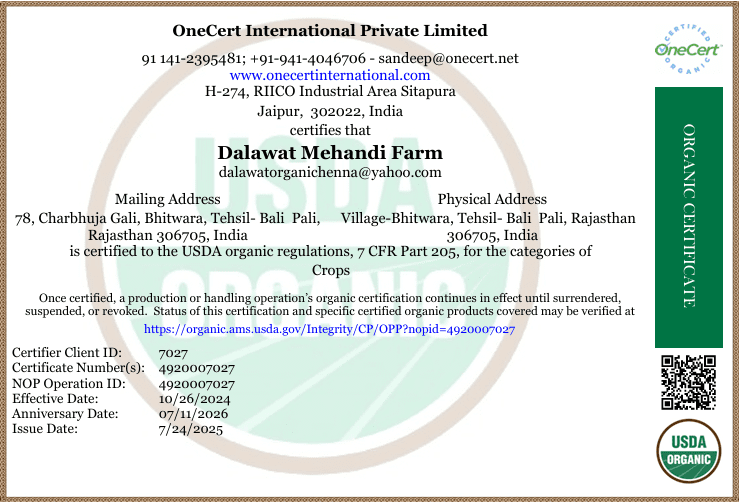
- USDA Organic (NOP) certification
- India Organic (NPOP) certification
We do not buy leaves from multiple farms.
We do not blend anonymous lots.
What you receive is henna that began life on this specific field.
📷 Hero Image Placeholder
Aerial or wide-angle photograph of the farm
Caption:
Field rows of Lawsonia inermis — Sojat, Rajasthan
Our certified organic henna farm in Pali district.
Farm overview
| Location | Crop | Certifications |
|---|---|---|
| Pali District, Rajasthan | Lawsonia inermis | USDA Organic (NOP) + India Organic (NPOP) |
Where the organic chain begins
Organic certification is a chain of custody.
That chain begins at a farm — a specific, inspected piece of land where cultivation practices are documented and verified against a published organic standard.
Without a legitimate farm certification, the rest of the organic supply chain cannot exist.
Every downstream claim — from the processor, exporter, or importer — depends on the farm’s certification being genuine, current, and verifiable.
Why single-source matters
Conventional henna leaves are sold as a commodity crop.
Leaves harvested from many farms are brought to a public market in large jute bags where:
- bags of leaves are sorted and co-mingled based on visual quality
- henna leaves are bought, stored and re-sold by traders to factories for processing
- factories process in large blended batches
This mixing creates a major problem.
When material from many farms is combined, testing samples no longer represent the final product. Think about that next time you see a laboratory test result showing a henna powder with 2.96% Lawsone Pigment: there is no reason to believe the sample used for that test has any relationship with the henna in the package.
In other words:
If the supply chain mixes sources, testing becomes unreliable.
Single-source henna solves this problem.
When every leaf comes from the same field and harvest batch:
- the powder is uniform
- lab samples represent the batch
- traceability is real
Single-source traceability is not a marketing slogan.
It is the structural requirement that makes testing meaningful.
You can see the farm on the map
📷 Satellite Map Placeholder
Satellite view of the farm showing:
- the cultivated field
- the on-site processing building at the center of the plot
Caption:
The henna field and processing facility — visible from satellite imagery
The entire operation — cultivation, drying, milling, and packaging — takes place on this single property.
Single-Source: grown on one field
📷 Plant close-up placeholder
Close-up of henna leaves (Lawsonia inermis)
Caption:
Henna plants grown on the farm at peak dye content.
📷 Harvest photo placeholder
Farmers harvesting henna leaves
Caption:
Henna leaves harvested by hand.
The farm follows both U.S. and Indian organic farming standards.
This means:
- no synthetic pesticides
- no synthetic herbicides
- no synthetic fertilizers
Cultivation practices are documented and inspected annually by accredited certification agencies.
Our henna crop is harvested once per year, when the leaves reach peak lawsone content — the natural dye molecule responsible for henna’s color.
Single-Source: processing and packaging on the farm
📷 Processing building placeholder
The processing building located at the center of the farm.
Caption:
The on-farm drying, milling, and packaging facility.
After harvest, the leaves are processed directly on the farm.
There is:
- no third-party processing
- no third-party milling
- no intermediate storage
The process is simple and controlled:
- Leaves are shade-dried
- Dried leaves are filtered and cleaned
- Leaves are milled into fine powder
- Powder is sealed into retail packaging
The product never leaves the farm until it is already packaged.
📷 Drying photo placeholder
Henna leaves drying under shade.
Caption:
Shade-drying preserves the natural dye molecule (lawsone).
📷 Packaging photo placeholder
Retail pouches being filled and sealed.
Caption:
Henna powder sealed into retail packaging on the farm.
Both the USDA NOP and India NPOP programs require a separate organic handling certification for any facility that processes or packages organic products.
Our farm holds both crop and handling certifications.
India’s APEDA TraceNet system records the conversion ratio from leaf to powder for each milling run, preventing any downstream party from inflating volume or substituting material.
The Workers
📷 Henna workers portrait placeholder
Portrait of the farm family.
Caption:
The family who grows and processes Hennaran™ henna.
📷 Farm detail placeholder
Working photo in the field or soil detail.
Caption:
Daily work on the farm in Pali district.
This is not an anonymous agricultural supplier.
It is a working family farm that cultivates, processes, and documents its organic crop under internationally recognized certification systems.
Four active organic certifications
Two certifications cover crop production.
Two cover the on-site processing facility.
Click any certificate below to view the full document.
📄 NOP Crop Certificate
📄 NOP Handling Certificate
📄 NPOP Crop Certificate
📄 NPOP Handling Certificate
Renewed annually through third-party inspection.
Last updated: [Month, Year]
Publicly verifiable certification
Both certification programs are publicly searchable.
You can verify the farm’s status in:
- the USDA Organic INTEGRITY Database
- the APEDA TraceNet registry
No special access is required.
Transparency should not depend on trust alone.
See the full supply chain
The farm is only the first step.
From there, the henna moves through a fully documented USDA-Organic supply chain including:
- TraceNet transaction certificates
- export documentation
- USDA NOP import certificates
- independent laboratory testing
See our article:
→ USDA Organic Henna Supply Chain
Questions about the farm or certification?
Contact us directly.
====
Organic Henna Farm
Every certified USDA-Organic product is only as good as the farm it started from: Our henna comes from one farm — a single USDA-Organic (NOP) and India Organic (NPOP) certified organic family farm in Rajasthan. It is grown, processed, and packaged at this single-source.
📷Aerial or wide-angle view of the farmField rows of Lawsonia inermis — Sojat, RajasthanOur farm, Sojat, Pali district, Rajasthan
| Location Sojat, Pali, Rajasthan | Crop Lawsonia inermis | Certifications NOP + NPOP Organic |
The farm is where our organic chain begins
Organic certification is a chain of custody. It starts at a farm — a specific, inspected plot of land whose inputs are documented and whose practices have been verified against a published standard. No farm, no chain. Every downstream claim — the processor’s, the exporter’s, the importer’s — depends on that originating farm certifications being real and current.
Why single-source matters
Conventional henna is sold as a commodity and large jute bags from different farms are co-mingled and their leaves are mixed by conventional henna factories. This co-mingling and mixing of henna leaves from many farms is not uniform and test samples cannot meaningfully represent the contents of the finished products. One clean-farming contributor can statistically mask a contaminated one. Single-source traceability isn’t a marketing point. It’s the structural requirement for testing to mean anything.
You can see it on the map
The satellite view below shows the farm — the field and the on-site processing building at the centre of the plot.
Single-Source: Grown on one field
📷Close-up of henna plants Lawsonia inermis leaves Lawsonia inermis at peak dye content
📷Farmers harvesting Hand-cutting leaves in the field Harvested by hand
The farm follows USA and India organic standards: no synthetic pesticides, herbicides, or fertilizers. Our henna is harvested once a year, at peak lawsone content.
Single-Source: Processing and packaging
📷On-farm drying, milling, and packaging The building at the center of the farm — visible on the satellite map above
After harvest, the leaves are processed directly on the farm according to its US and India organic handling certifcations. No off-site processing, no third-parties, no intermediate storage. Leaves are shade-dried, filtered, milled into to powder and sealed into retail packaging without ever leaving the farm.
Both NOP and NPOP require a separate handling certificate for any facility that processes or packages certified organic product. Our farm holds both crop and handling certificates under both programs. India’s APEDA TraceNet records the conversion ratio from leaf to powder at every milling run, preventing volume inflation by any party downstream.
📷Drying Shade-dried leaf Shade-drying preserves lawsone
📷Packaging Filled and sealed on the farm Sealed before leaving the farm
The family
📷Family portraitThe farmers who grow and process the henna The farm family, Rajasthan
📷Farm detail Field, soil, or a working shot Pali district
Four active certifications
Two covering crop production. Two covering the on-site handling facility. Click any thumbnail to view the full document.
NOP
Crop Certificate📄NOP
Handling Certificate📄NPOP
Crop Certificate📄NPOP
Handling Certificate
Renewed annually by third-party inspection. Last updated: [month, year].
Both certifications — NOP (USDA) and NPOP (India/APEDA) — are publicly verifiable. You can look up the farm’s active certification status in the USDA Organic INTEGRITY Database and the APEDA TraceNet registry without asking us.
For the full supply chain documentation — TraceNet, NOP Import Certificates, lab testing — see our USDA Organic supply chain article. Questions? Contact us directly.
end of page
original page contents\:
Farm & Organic Certification

Introduction
Henna is an agricultural product. Its quality depends on soil, climate, harvest timing, drying conditions, processing temperature, storage, and freshness. Hennaran Organic Henna Powder overcomes these variables because it is grown, processed and packaged from a single certified-organic farm.
The Farm Behind Every Pouch
Our henna comes from a single family farm in Rajasthan, India, where Lawsonia inermis has been cultivated for generations.
Our henna is not purchased from the local market where henna leaves are sold as a commodity, blended from any number of sources, remixed and resold, processed and packaged by intermediaries.
Key characteristics:
– Small family farm
– Dedicated henna cultivation
– Controlled harvesting and drying
– Direct relationship, not spot-market purchasing
Geolocation map of the Farm

Complete USDA Organic Certification
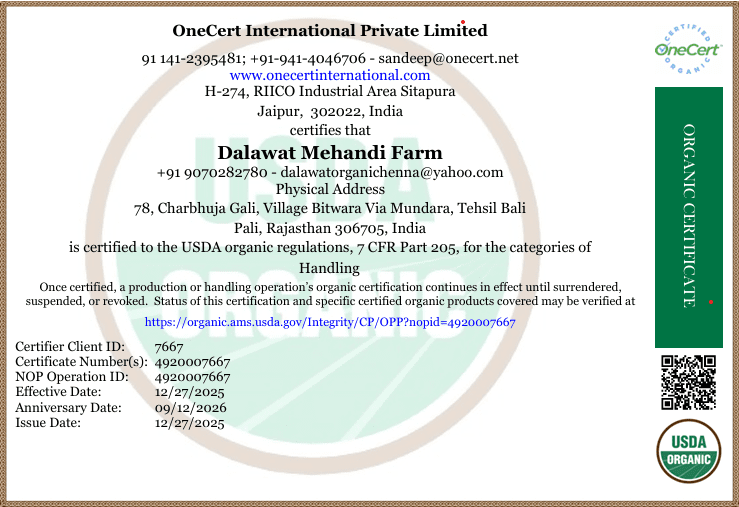
Our henna is grown, processed and packaged on a small family farm in Rajasthan – both the farm and its processing have valid USDA Organic certifications.
USDA Organic Farm
USDA Organic Factory
Our Journey